
People already use AI. Companies are still catching up
More than half of people in Portugal already use AI tools and almost a third do so at work. Among companies, it is one in five. That gap is worth a closer look.

November’s numbers
On 20 November, Statistics Portugal (INE) published its 2026 surveys on the use of technology by households and by companies. On the people side, 54.4% of residents aged 16 to 74 already use artificial intelligence tools, 17 percentage points more than in 2025. Almost a third, 30.7%, use them for work.
Among companies with ten or more people, the share that reports using AI rose from 11.5% to 19.6%. Even so, it is well below what people already do on their own.
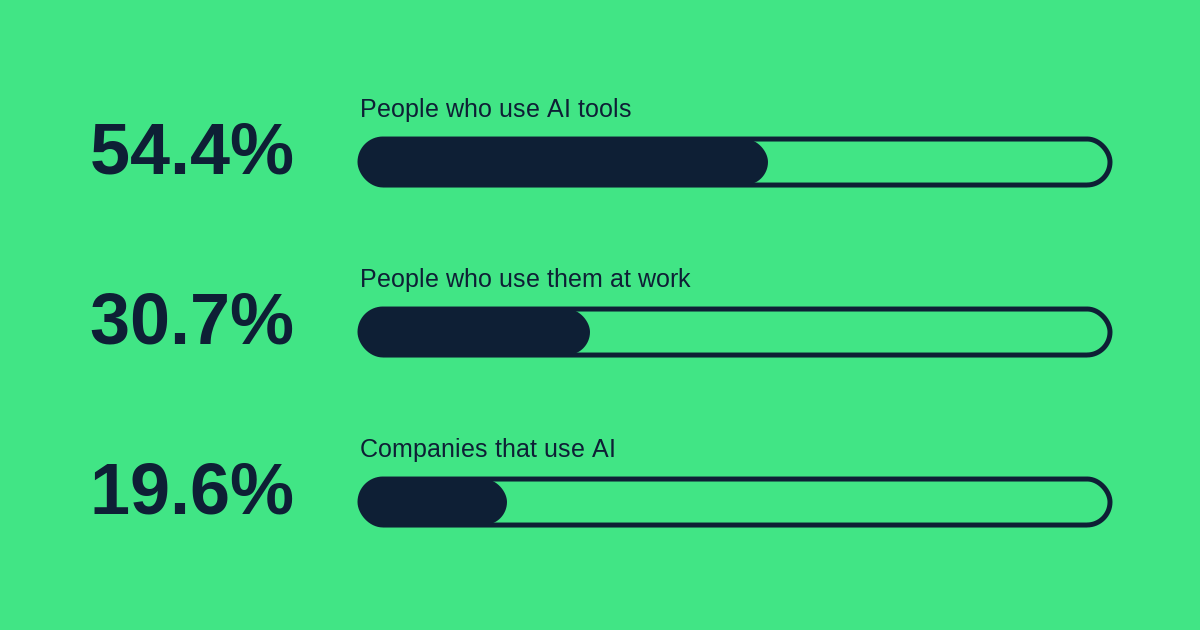
Source: Statistics Portugal (INE), surveys on the use of information and communication technologies, 2026.
AI comes in through the back door
The two surveys do not measure exactly the same thing, but they point the same way: more people use AI at work than there are companies saying they use it.
A Cegid study, carried out by OpinionWay in four European countries and released in August, gives a measure of this. Among the Portuguese professionals surveyed, 69% say they use AI tools from outside the organisation without telling their employer.
This is not bad faith. It is someone with a report to summarise or a difficult email to write, who found some help and used it.
Why this matters
The first problem is data. When each person picks their own tool, nobody knows which customer documents were pasted where, or on what terms they are stored.
The second is checking. A text generated in a hurry and sent without review carries the company’s name, not the tool’s.
The third is less obvious: the gain stays with whoever discovered the trick. The colleague at the next desk keeps doing the same task by hand, and the company learns nothing from it.
What people have already found out
There is good news in these numbers. People have already shown where AI is useful to them, and they did it without anyone asking.
Among companies that use AI, the most common technology is written-language analysis, present in 62.2% of them, according to INE. It is the same thing people do on their own: read, summarise, write, search. Work with text and documents is where fatigue builds up, and that is where the help comes in.
What to do about it
Banning rarely solves it. Someone who found a way to save an hour a day does not go back willingly; they simply stop saying so.
Asking works better. Knowing which tasks the team already hands to these tools says more about where the repetitive work is than any process survey.
Then pick one of those tasks and treat it seriously: an approved tool, clear rules about which data can go in, and a person who reviews the result. The article Start with the problem, not the model has three questions for making that choice.
Your team has probably already started. What is missing is for the company to go and meet it.